
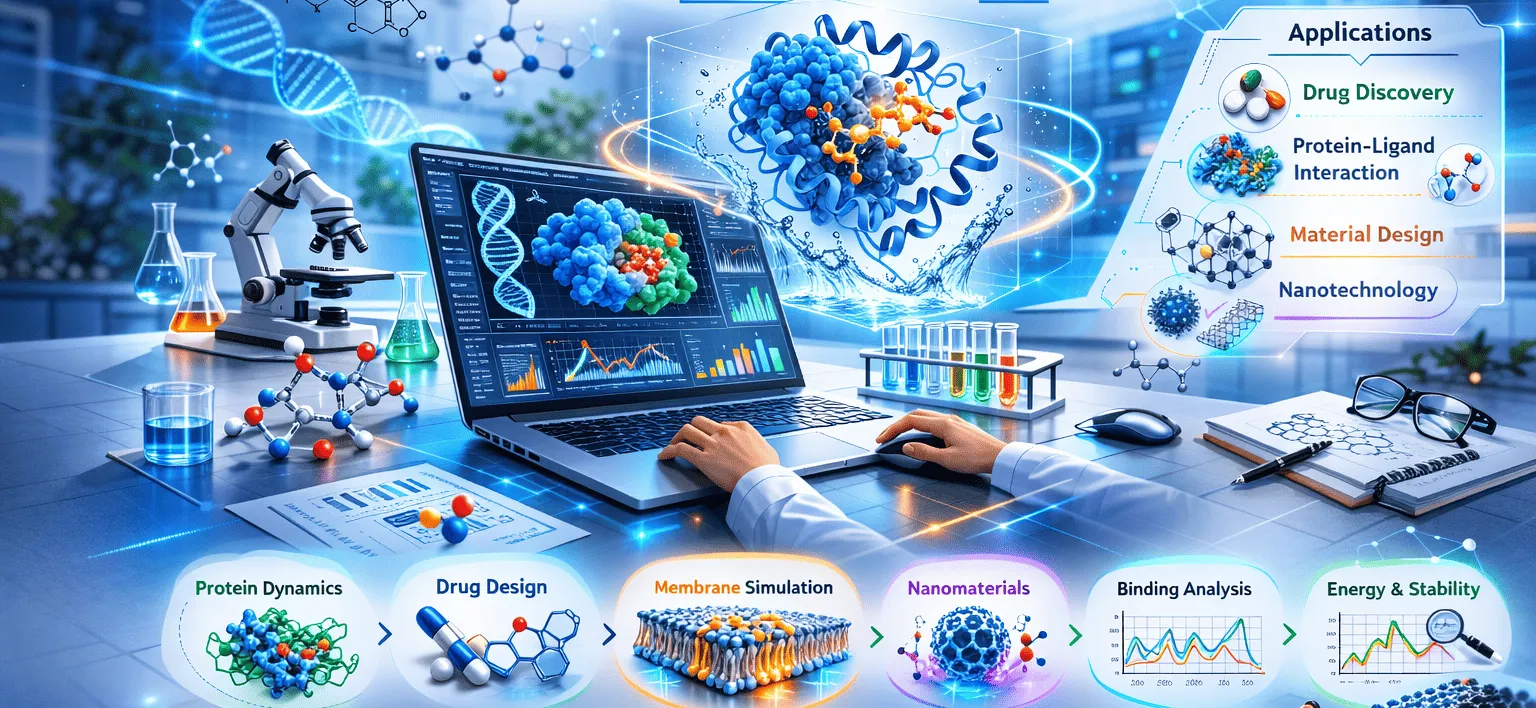
Molecular Dynamics (MD) Simulation for Biomolecular & Material Systems
Perform high-accuracy molecular dynamics simulations to investigate the structural, dynamic, and thermodynamic behavior of biomolecular and material systems using validated computational methodologies and high-performance computing.
Overview
Molecular Dynamics (MD) simulation is a powerful computational approach for investigating the structural, dynamic, and thermodynamic behavior of molecular systems at atomic resolution. At TSLab, we provide end-to-end MD simulation services for both biomolecular and material systems, enabling researchers and industries to understand molecular mechanisms, evaluate structural stability, predict material performance, and accelerate scientific discovery through reliable computational modeling.
Our simulations are performed using validated computational protocols, state-of-the-art force fields, and high-performance computing (HPC) infrastructure to ensure scientific accuracy, reproducibility, and computational efficiency. In addition to utilizing established force fields, TSLab also specializes in the development, parameterization, validation, and optimization of custom force fields for non-standard molecules and complex systems, including metal complexes, novel ligands, advanced materials, polymers, nanomaterials, and other systems where standard parameters are unavailable or insufficient. Every workflow—from system preparation and parameterization to production simulation and advanced trajectory analysis—is carefully tailored to meet the scientific objectives of each project.
Applications
Our MD simulation services support a broad range of systems, including:
- Proteins, peptides, and enzymes
- Protein–ligand and protein–protein complexes
- DNA, RNA, and nucleic acid systems
- Lipid membranes and membrane proteins
- Metal complexes and coordination compounds
- Polymers and polymer composites
- Nanomaterials and functional materials
- Catalysts and porous materials
- Organic and inorganic molecular systems
Analysis Capabilities
- Structural Stability Analysis – RMSD, RMSF, Radius of Gyration (Rg), SASA, secondary structure, and structural convergence.
- Molecular Interaction Analysis – Hydrogen bonds, salt bridges, hydrophobic interactions, π-interactions, contact maps, and interaction networks.
- Conformational Dynamics – Principal Component Analysis (PCA), Dynamic Cross-Correlation Matrix (DCCM), essential dynamics, and clustering analysis.
- Thermodynamic Analysis – Energy profiles, temperature, pressure, density, heat capacity, and equilibrium assessment.
- Transport & Diffusion Analysis – Mean Square Displacement (MSD), diffusion coefficients, permeability, and transport properties.
- Binding Free Energy Analysis – MM/PBSA, MM/GBSA, Umbrella Sampling, Thermodynamic Integration (TI), Free Energy Perturbation (FEP), and other free-energy methodologies.
- Membrane System Analysis – Lipid order parameters, membrane thickness, area per lipid, and membrane–protein interactions.
- Material Characterization – Mechanical, structural, thermal, and dynamic property evaluation of polymers, nanomaterials, catalysts, and functional materials.
- Force Field Development & Validation – Development, parameterization, benchmarking, and validation of custom force fields for novel molecules, metal-containing compounds, and advanced materials.
- Trajectory Processing & Visualization – Publication-quality figures, molecular animations, and comprehensive analytical reports.
Contact
Jl. Tamalate 3 no. 136 Makassaar
contact@tslab.id
6282-33333-1270